.svg)
Salon & Spa Fit Out in Dubai: Design Tips, Costs & Approvals for Beauty Businesses (2026)
Dubai has established itself as a global wellness and beauty destination. With over 14,000 beauty salons, spas, and wellness centres across the emirate — and a client base that expects premium experiences, flawless interiors, and genuine expertise — the health and beauty sector is one of the most active commercial fit out markets in the city.
But fitting out a salon or spa in Dubai is not simply a design exercise. It is a multi-authority compliance process with specific layout requirements, hygiene standards, licensing obligations, and approval timelines that many beauty business owners discover for the first time when they are already mid-project.
A salon that passes Dubai Municipality's health and safety inspection is not just legally compliant — it is a salon designed to function safely, work efficiently, and create the kind of environment that clients return to. A salon that fails the DM inspection faces mandatory layout redesigns, reconstruction costs, and opening delays that typically run three to six additional weeks.
This guide covers everything you need to know before starting your salon or spa fit out in Dubai: verified 2026 cost data, the Dubai Municipality layout requirements that govern every salon, the approval and licensing process from DET trade licence through to DM health and safety sign-off, design tips that work in this specific market, and how the process differs for spas that offer treatment services governed by the Dubai Health Authority.
Verified Summary (2026)
Salon fit out cost in Dubai: AED 450-800 per sqft verified from real 2025-2026 projects (designdivine.ae, May 2026). A 150 sqft nail bar costs AED 135,000-250,000. A full salon of 300 sqft costs AED 280,000-600,000.
Licensing cost: DET trade licence AED 8,000-18,000 annually plus DHA health permit AED 3,000-6,000 annually (waj.ai, May 2026).
DM layout requirements: Minimum ceiling height 2.3 metres. Minimum 1 metre between hairdressing chairs. Minimum 0.5 metres between manicure or pedicure stations.
Why Salon and Spa Fit Out in Dubai Is More Regulated Than You Expect
Most beauty business operators entering the Dubai market for the first time are surprised by the level of regulatory specificity that governs salon interiors. Unlike an office or retail store, a salon or spa in Dubai must meet detailed health, safety, and hygiene standards that are built directly into the physical design of the space.
These are the key characteristics that make salon and spa fit out in Dubai distinctly more complex than a standard commercial fit out.
- Dubai Municipality inspects every salon before licensing: Dubai Municipality's Health and Safety Department reviews your salon layout before you can open. This means your architect and fit out company must prepare drawings that comply with DM's specific technical standards for salon spaces — ceiling height, workstation spacing, zoning of service areas, ventilation, surface materials, and fire safety. A layout that was designed by someone unfamiliar with DM's salon-specific requirements will be rejected at the drawing review stage.
- Salons and spas have different regulatory tracks: Salons offering hair and beauty services operate under a DET trade licence with DM health and safety approval. Spas and wellness centres that offer body treatments, massage, or energy therapies must additionally navigate the Dubai Health Authority (DHA) track for therapist registration and treatment device approval. Medical-grade services — laser hair removal, Botox, chemical peels, microneedling, and injectables — require specific DHA approvals that are separate from the standard spa licence and dramatically affect the fit out design.
- Service zones must be physically separated: Dubai Municipal regulations require distinct, physically separated zones for different service categories. A salon that offers hair, nails, facials, and waxing cannot simply place stations wherever fits; each service category must have its own defined and partitioned area. This spatial requirement directly shapes the floor plan from the first design iteration.
- Products and devices require individual approvals: All cosmetics, treatment products, and devices used in a salon or spa must be registered with or approved by Dubai Municipality (through the Montaji system for cosmetics) or the DHA (for treatment devices). Products that are not registered cannot legally be used on clients. This requirement does not affect the fit out directly but must be planned for when specifying treatment rooms and equipment storage.
Understanding Salon and Spa Licence Types in Dubai
Before designing your fit out, you need to confirm which licence type you are applying for — because the licence type determines the specific DM layout requirements, the DHA track that applies, and the services you are legally permitted to offer. Getting this wrong at the design stage means redoing drawings after the licence application is submitted.
Important for medical-grade services: If your salon or spa concept includes laser hair removal, Botox, fillers, microneedling, or any injectable treatments, you are operating a medical facility under UAE law. This requires a DHA healthcare facility licence — not a standard DET trade licence. The fit out must meet medical clinic standards, which are significantly different from standard salon specifications. Do not design a salon-standard fit out for a medical spa concept.
Dubai Municipality Salon Layout Requirements: What the Law Specifies
Dubai Municipality's Health and Safety Department has published detailed technical requirements that must be incorporated into every salon fit out design submitted for approval. These are not guidelines or suggestions — they are mandatory specifications that are checked at the drawing review stage and again at the physical inspection before licensing is issued.
The following requirements are verified from Dubai Municipality's technical standards as documented by daemuae.com (December 2025), fitoutapprovals.com (April 2025), and intellectca.ae (April 2026).
Spatial and Dimensional Requirements
- Ceiling height: Minimum ceiling height: 2.3 metres throughout the entire salon. No exceptions. (Source: daemuae.com, Dec 2025; intellectca.ae, Apr 2026)
- Hairdressing stations: Hairdressing chair spacing: Minimum 1 metre between each styling chair. (Source: fitoutapprovals.com, Apr 2025; intellectca.ae, Apr 2026)
- Nail stations: Manicure and pedicure station spacing: Minimum 0.5 metres between each station. (Source: fitoutapprovals.com, Apr 2025)
- Workstation area: Workstation dimensions: Minimum 2.50 metres x 1.50 metres per workstation area. (Source: daemuae.com, Dec 2025)
- Minimum floor area: Minimum salon size: A two-chair salon must have a minimum floor area of 3m x 4m (12 sqm). (Source: fitoutapprovals.com, Apr 2025)
- Reception and waiting: Waiting area separation: The reception and waiting area must be positioned at least 2 metres away from active service zones. (Source: daemuae.com, Dec 2025)
Zoning and Separation Requirements
- Service zone separation: Each service category must have its own clearly defined and separately partitioned zone. Hair styling, nail care, facial treatments, and waxing cannot share the same unpartitioned space in a multi-service salon.
- Gender separation: A unisex salon must have completely separate sections for male and female clients, each with their own entrance if possible, or with clear physical separation preventing visual contact between zones. (Source: corplex.ae, May 2026)
- Sterilisation area: Sterilisation and tool cleaning equipment must be placed in a dedicated, clearly marked zone — not at a shared workstation or in a shared storage area.
Surface Material Requirements
- Surfaces in wet and chemical zones: All surfaces in areas where water or chemicals are used — washing stations, facial treatment rooms, pedicure areas — must be non-porous, stain-resistant, and easily cleanable. Glass and granite are specifically cited as acceptable. Timber and fabric are not acceptable in wet or chemical treatment zones. (Source: intellectca.ae, Apr 2026)
- Flooring: Floors throughout the salon must be smooth, non-slip, and cleanable. Porous materials such as natural stone without sealing, unsealed grout, or carpet in treatment areas are not accepted.
Ventilation Requirements
- Chemical fume extraction: Mechanical ventilation or air isolation systems are mandatory for all areas where chemical fumes may be present — nail stations (where acetone and lacquers are used), hair colouring stations (where peroxide and ammonia-based products are used), and waxing rooms. Standard AC alone does not meet this requirement. (Source: daemuae.com, Dec 2025; designdivine.ae, May 2026)
- Treatment room ventilation: Each treatment room must have adequate air exchange to prevent the accumulation of humidity and odours from body treatments and steam. Standalone mechanical exhaust systems are required, not just AC diffusers.
Additional DM Requirements
- Dedicated washbasins: Washbasin specifically designated for facial treatment areas (separate from hair washing basins). (Source: corplex.ae, May 2026)
- Hot water supply: Water heater must be installed in the salon. (Source: corplex.ae, May 2026)
- Equipment storage: Storage cupboards and drawers for cosmetics and towels in compliant, cleanable cabinetry.
- Fireproof materials: Fireproof materials are mandatory in areas designated for hair removal treatments that involve heat. (Source: corplex.ae, May 2026)
- Lighting: Adequate lighting at every workstation — either natural or artificial. Poor workstation lighting is a documented DM inspection rejection reason.
DM Inspection Reality Check: Dubai Municipality conducts a mandatory physical site inspection before your salon licence is issued. Inspectors check that the fit out exactly matches the approved drawings. Any deviation — moved partition, added station, modified ventilation layout — will cause the inspection to fail. Build exactly as drawn. Do not make design decisions on-site without first amending the approved drawings.
The Complete Salon Fit Out Approval and Licensing Process in Dubai
Opening a beauty salon or spa in Dubai involves two parallel tracks: the commercial track (DET trade licence) and the construction and health track (DM fit out permit and health and safety sign-off). Both must be completed before you can legally open to clients.
- Reserve your trade name with the Department of Economy and Tourism (DET). Choose a unique name complying with UAE naming rules. Budget 1-3 days and a nominal name reservation fee.
- Obtain initial DET approval (the preliminary licence) confirming your chosen salon activity is approved. This is not the final trade licence — it is the starting point that enables you to proceed with other steps.
- Sign your commercial lease and register it through Ejari. The Ejari-registered tenancy contract is required as a supporting document in your DM submission. Without a registered lease, DM will not process your application.
- Engage a DM-licensed architectural consultant and prepare the full drawing package: architectural drawings (floor plan, reflected ceiling plan, section and elevation drawings), MEP drawings (electrical load schedule, AC layout, plumbing and ventilation plan), and fire safety layout drawings. All drawings must comply with DM technical standards for salon spaces.
- Submit your drawings simultaneously to Dubai Municipality (Health and Safety Department, planning section) and Dubai Civil Defence (DCD). DM reviews for layout compliance, zoning, ventilation, and surface standards. DCD reviews for fire alarm, suppression, and emergency system compliance. Parallel submission saves 3-5 weeks versus sequential submission.
- DM draws review: 5-15 working days for standard submissions. Comments and revisions are common if the salon layout does not fully comply at the first submission. Revise and resubmit promptly — each round of revision adds 1-2 weeks.
- Once DM drawing approval is received, commence fit out works. Build exactly as per the approved drawings. No on-site design decisions that deviate from the approved set.
- Simultaneously: register all cosmetics and products used in the salon through the Dubai Municipality Montaji portal. This is a mandatory product registration system and is checked during the DM inspection. Products not registered in Montaji cannot be used in the salon.
- For spas offering body treatments and massage: register each therapist with the DHA and register each treatment device through the DHA device approval process. The DHA registration of therapists and devices is separate from the DM and DET process. Timeline: 4-10 weeks from submission. (Source: diac.ae, Mar 2026)
- Upon completion of fit out, request DM final inspection. The inspector visits the physical premises and verifies compliance against the approved drawings. If passed, the salon health and safety sign-off is issued.
- Activate your DET trade licence using the DM sign-off, Ejari contract, and other required documents. Issue Occupational Health Cards (OHC) for all staff through DHA. (Source: intellectca.ae, Apr 2026)
- Open to clients. Maintain the Montaji product registration, renew DET trade licence annually, and renew DHA health cards for all staff annually.
Total process timeline (verified): With parallel submissions and a compliant fit out design, the full process from lease signing to licence issuance typically takes 6-12 weeks. Delays most commonly arise from: non-compliant DM drawings requiring revision and resubmission (adds 2-4 weeks per revision round), failed DM physical inspection due to deviation from approved drawings (adds 3-6 weeks for remediation and reinspection), and DHA therapist registration delays due to incomplete credential documentation (adds 2-4 weeks). Source: diac.ae, Mar 2026.
Salon and Spa Fit Out Cost in Dubai: Verified 2026 Data
The following cost figures are drawn from verified 2025-2026 sources. Sources are cited for each data point.
Fit Out Cost Per Sqft
Example Total Costs by Salon Size (Verified)
Annual Licensing Costs (Verified 2026)
Where the Fit Out Budget Is Spent
Salon and Spa Design Tips for the Dubai Market
Beyond compliance, a well-designed salon or spa in Dubai creates a competitive advantage in a crowded market. These are the design principles that Dubai's most successful beauty businesses use to attract and retain clients.
1. Design the Compliance Into the Layout First — Then Design the Aesthetic
The biggest mistake salon designers make in Dubai is starting with the aesthetic vision and then trying to retrofit the DM compliance requirements. The correct sequence is the opposite: start with a DM-compliant floor plan that correctly zones all service areas, meets minimum spacing requirements, and routes extraction and plumbing correctly. Then design the aesthetic around that compliant layout. This approach eliminates resubmission delays and prevents expensive post-construction modifications.
2. Reception and Waiting Area: The First Impression That Builds Brand
Dubai beauty clients are visually discerning and social-media-conscious. The reception and waiting area is the first physical touchpoint with your brand and the zone most likely to be photographed and shared. Investment in a distinctive, high-quality reception desk, curated lighting, branded fragrance, and a comfortable waiting experience pays returns in client perception far beyond its cost. The DM requirement for 2 metres of separation between reception and service zones creates a natural design opportunity: use this separation to create a distinct, branded zone.
3. Lighting: The Most Important Atmospheric Tool in a Salon
Salon lighting in Dubai must serve two simultaneous purposes: adequate, accurate workstation lighting that meets DM's technical requirements AND ambient and accent lighting that creates the atmosphere clients are paying for. Layered lighting — task lighting at each workstation (daylight-balanced LED), ambient ceiling lighting, and accent or backlit feature elements — achieves both simultaneously. Do not use purely warm ambient lighting in a beauty salon: warm light makes it impossible for stylists and beauticians to accurately assess colour, skin tone, and detail.
4. Ventilation as a Design Element, Not a Mechanical Afterthought
Chemical fume extraction at nail stations and hair colouring zones is a DM and DCD requirement that is often treated purely as a mechanical element — resulting in visible ductwork and ceiling penetrations that detract from the aesthetic. The correct approach is to plan extraction routes as part of the ceiling design from the start, concealing ductwork within the ceiling cavity or incorporating it into feature ceiling elements. This requires coordinating the MEP design and the architectural ceiling design simultaneously — which is why a fit out company that manages both disciplines in-house delivers better results than one that coordinates MEP as an afterthought.
5. Treatment Room Design for Spas: Privacy, Calm, and Material Quality
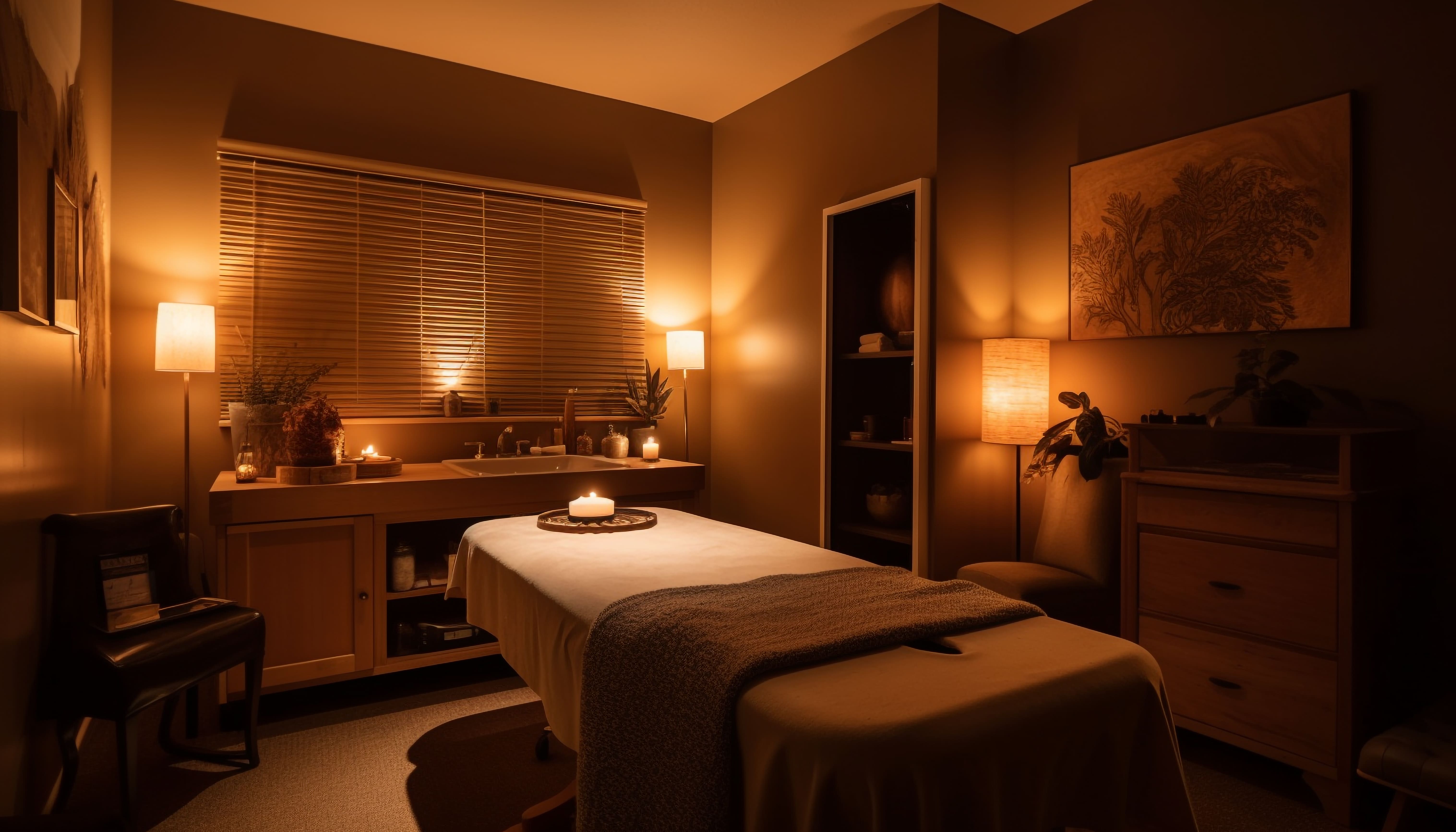
For spa treatment rooms, Dubai clients expect three things: complete privacy (floor-to-ceiling partitioning, no sound bleed from adjacent rooms or the front of house), a calming acoustic and visual environment (warm materials, indirect lighting, natural elements), and impeccable cleanliness. The surface materials in treatment rooms must meet DM's non-porous, cleanable standards while also delivering the sensory warmth that spa clients pay for. Microcement on walls, large-format porcelain on floors, and indirect LED behind joinery or ceiling coves achieves both simultaneously.
6. Product Display and Retail Area: A Revenue Opportunity in Every Salon
A well-designed retail product display integrated into the reception or waiting zone converts browsing clients into additional revenue without requiring additional staff or marketing. In Dubai salons, clients frequently purchase the products used during their treatment. A dedicated, well-lit retail display — designed as part of the salon's aesthetic rather than as an afterthought — can add 10-25% to per-client revenue. All products displayed for retail must be registered through Montaji.
Salon Fit Out Timeline in Dubai: What to Expect
Realistic total timelines:
Simple nail bar or small beauty counter: 6-8 weeks
Standard ladies' or gents' salon 100-200 sqm: 10-14 weeks
Premium multi-service salon with spa elements: 12-18 weeks
Full day spa with DHA-tracked treatment services: 14-22 weeks
Health & Beauty Fit Out with Malmo Interiors
Malmo Interiors delivers fit out projects across Dubai's health and beauty sector — salons, spas, and nail bars — alongside our residential and commercial portfolio. Our team manages the complete process from DM-compliant design through to authority approvals and handover.
What we deliver on every salon and spa fit out:
Free site assessment and concept consultation — We visit your space, confirm your licence type, assess the current condition, and advise on feasibility, DM layout requirements, and authority approval timelines before you commit.
DM-compliant layout design from day one — Our designers understand Dubai Municipality's technical standards for salons and spas. We produce layouts that pass DM review on the first submission, eliminating revision delays.
Parallel authority submission — We submit DM and DCD applications simultaneously on day one of the approval phase. We track submissions, respond to authority comments within 48 hours, and manage the inspection scheduling.
In-house MEP coordination — Chemical fume extraction, plumbing for washing stations, hot water installation, and DCD fire systems are all coordinated by our in-house team. No gaps between design and MEP coordination.
Transparent, itemised quotation — Every element of your salon or spa fit out is listed with specification, quantity, and unit cost. Partition walls, extraction, plumbing, joinery, flooring, and furniture — all itemised. No surprises.
Six-month post-handover snagging support — Any issue arising in the six months after we hand over your completed salon or spa, we return and resolve it at our cost.
See our completed commercial and health and beauty fit out projects in our portfolio, or visit our health and beauty fit out services page.
Frequently Asked Questions — Salon and Spa Fit Out Dubai
How much does a salon fit out cost in Dubai in 2026?
Verified 2026 data from designdivine.ae shows salon fit out costs in Dubai range from AED 450-800 per sqft for a standard beauty salon or nail bar. A 150 sqft nail bar costs AED 135,000-250,000. A full salon of 300 sqft costs AED 280,000-600,000. A premium spa with treatment rooms and wet areas runs AED 800-1,400+ per sqft. The biggest cost drivers are the number of washing stations and plumbing connections, the extraction ventilation requirement, and the level of custom joinery and reception design.
What DM layout requirements apply to salons in Dubai?
Dubai Municipality specifies: minimum ceiling height of 2.3 metres; minimum 1 metre between hairdressing chairs; minimum 0.5 metres between manicure or pedicure stations; minimum workstation area of 2.5m x 1.5m; minimum floor area of 3m x 4m for a two-chair salon; waiting area separated by at least 2 metres from service zones; separate partitioned zones for each service category; mechanical ventilation for all chemical fume areas; non-porous, washable surfaces in wet and chemical treatment zones. A mandatory site inspection verifies compliance before the licence is issued.
What licences do I need to open a salon in Dubai?
You need a DET (Dubai Department of Economy and Tourism) trade licence specifying your salon activity. Annual cost: AED 8,000-18,000 (waj.ai, May 2026). A DHA health permit is mandatory for salons offering any skin, nail, or cosmetic treatment services. Annual cost: AED 3,000-6,000 (waj.ai, May 2026). All staff require Occupational Health Cards from DHA. For spas offering body treatments, massage, or wellness therapies, additional DHA therapist registration is required for each practitioner. For medical-grade services (laser, injectables, chemical peels), a full DHA healthcare facility licence is required, which is separate from the standard DET trade licence.
Is a separate DHA approval needed for a salon in Dubai?
Yes — for salons offering any skin, nail, or cosmetic services, a DHA health permit is required in addition to the DET trade licence. For spas that offer body treatments, massage, or energy therapies, each therapist must hold a DHA professional registration and each electrically-powered treatment device must receive DHA device approval before use on clients. For medical-grade services (laser, Botox, microneedling, fillers), the regulatory requirement escalates significantly: a DHA healthcare facility licence is required and all practitioners must hold DHA medical professional licences.
How long does a salon fit out and licensing process take in Dubai?
A simple nail bar or small beauty salon takes 6-8 weeks from design start to licence issuance. A standard ladies' or gents' salon of 100-200 sqm takes 10-14 weeks. A premium multi-service salon takes 12-18 weeks. A full day spa with DHA-tracked treatment services takes 14-22 weeks. Common causes of delay: non-compliant DM drawings requiring revision (adds 2-4 weeks per round), DM physical inspection failure due to deviation from approved drawings (adds 3-6 weeks for remediation), and DHA therapist registration delays due to incomplete credential documentation (adds 2-4 weeks). Source: diac.ae, Mar 2026.
Can a salon in Dubai offer laser treatments or Botox?
Only with DHA medical facility licensing. Laser hair removal, Botox, dermal fillers, chemical peels, microneedling, PRP, and all injectable treatments are classified as medical procedures under UAE law. Offering these services under a standard DET beauty salon trade licence is illegal and risks immediate closure and significant fines. A separate DHA healthcare facility licence must be obtained, all practitioners must hold DHA medical professional licences, and the fit out must meet medical clinic design standards — which are substantially different from standard salon requirements.
Ready to Plan Your Salon or Spa Fit Out in Dubai?
Opening a salon or spa in Dubai is a genuine business opportunity in one of the world's most active wellness markets. But the compliance process — DM layout approval, DHA licensing, DCD fire safety, Montaji product registration — is complex enough that working with an experienced fit out company is not just convenient, it is essential to opening on time and within budget.
Malmo Interiors manages salon and spa fit outs from DM-compliant design through to authority approvals and handover. We start with a free site assessment and honest advice on your specific licence type, approval requirements, and realistic costs. No surprises.
.png)
.svg)
.svg)
.svg)
.svg)