.svg)
Restaurant Fit Out in Dubai: Costs, Approvals, Trakhees & Tips for F&B Owners (2026)
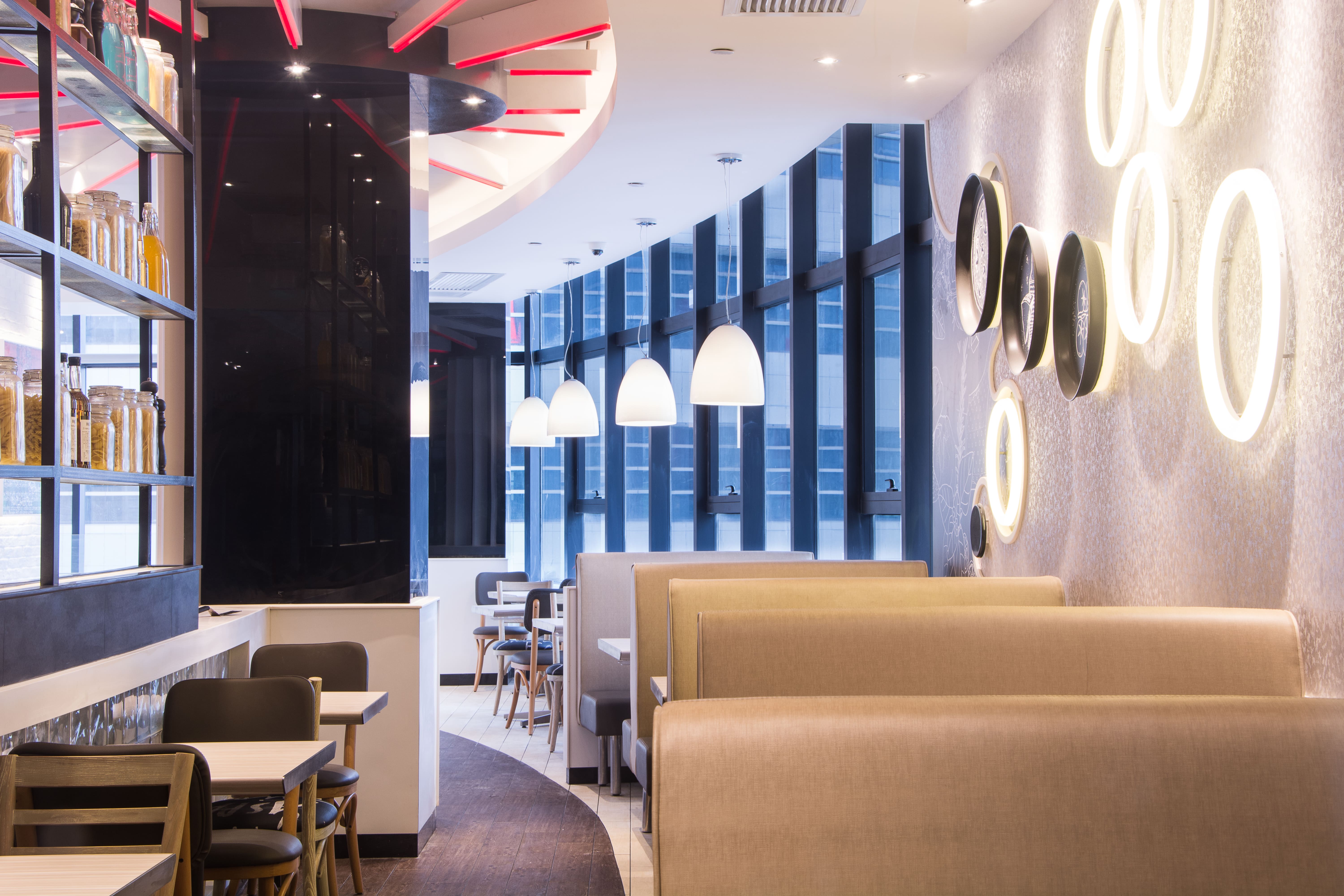
Dubai is one of the world's most competitive restaurant markets. With over 14,000 licensed food and beverage outlets across the emirate, Dubai's F&B sector continues to grow, driven by a diverse resident population of 3.7 million, year-round tourism, and a culture that places dining at the centre of social life.
But opening a restaurant in Dubai is also one of the most approval-intensive projects in the region. A restaurant fit out in Dubai does not just require a good designer and a capable contractor. It requires a minimum of three separate authority approvals — each with its own drawings, portal, timeline, and inspection process — before you can legally open to guests. Many F&B operators discover this reality too late, losing weeks of rent while chasing approvals they were not told about at the outset.
This guide gives you the complete picture, based on verified 2026 data: what a restaurant fit out costs in Dubai, how the approval process works (and which authority governs your specific location), what the DCD kitchen suppression updates mean for your project, and the practical tips that reduce your time to opening.
Every cost figure and regulatory detail in this article has been verified from current 2026 sources. We do not include estimates or assumption-based figures.
Verified Quick Summary (2026)
Restaurant fit out cost in Dubai: AED 300-900+ per sqft for a mid-range project. A 150 sqm casual dining restaurant costs approximately AED 700,000-1,500,000 all-in including kitchen, MEP, and fit out. Fast food and QSR concepts run AED 300-500 per sqft. Fine dining starts from AED 900 per sqft and can exceed AED 1,500.
Minimum authority approvals required: 3 (fit out permit from DM/DDA/Trakhees + DCD fire safety NOC + DM Food Safety permit). LPG gas installations add a fourth approval.
Timeline from design to opening: 10-18 weeks for a mid-sized restaurant when approvals run in parallel from day one.
Why Restaurant Fit Out in Dubai Is More Complex Than You May Expect
Dubai's F&B market is one of the most dynamic — and most regulated — food service environments in the world. Several features of the Dubai market make restaurant fit out significantly more complex than in most other countries.
- Three or more regulatory bodies: Multiple approval bodies with different portals, drawing formats, and inspection criteria. A mainland restaurant may require simultaneous submissions to Dubai Municipality, Dubai Civil Defence, and DM Food Safety. A free zone restaurant adds Trakhees, DDA, or DMCC to the stack. Each authority has different formats, different fees, and different completion certificates.
- Kitchen compliance is highly technical: Commercial kitchen ventilation, fire suppression, grease management, and gas installations are the most technical and most-failed elements of restaurant approvals in Dubai. DCD updated its kitchen suppression specifications in Q1 2026, introducing new K-class agent quantity calculations for deep-fat fryers and mandatory smart monitoring connections. Restaurants with existing suppression systems must meet the new standard at licence renewal.
- Smart monitoring is mandatory from 2026: Dubai Civil Defence connected smart monitoring (Hassantuk) is now mandatory for all restaurant, cafe, and cloud kitchen premises from 2026, including at licence renewal. The annual monitoring contract costs AED 1,200-2,400. Without it, a DED trade licence renewal cannot be processed.
- Kitchen layout must pass inspection: The DM Food Safety permit requires a physical kitchen inspection after construction is complete. HACCP flow separation — keeping raw food preparation, cooked food handling, dishwashing, and storage physically separate — is the most commonly failed criterion. If the kitchen is built to the wrong layout, the entire kitchen may need to be partially reconstructed before the food safety permit is issued.
- Your location determines your authority: Whether your restaurant is in a mainland area, a Nakheel community, a TECOM free zone, or a PCFC free zone changes which authority issues your fit out permit and which specific approval path applies. Using the wrong portal causes immediate rejection and weeks of lost time.
Which Authority Governs Your Dubai Restaurant? (The Most Important Question)
Before preparing a single drawing, you must identify which planning authority has jurisdiction over your restaurant's location. This is the single most common source of approval delays in Dubai F&B fit outs.
How to identify your planning authority:
Search your plot number at dm.gov.ae. If your plot appears, Dubai Municipality (DM) is your primary planning authority. If it does not appear, you are in a free zone — see the table below.
Important: Submitting to the wrong authority causes immediate rejection and requires restarting the submission from scratch with the correct portal, correct drawing format, and correct fee payment. Always verify your plot number at dm.gov.ae before any design work begins.
The Complete Restaurant Fit Out Approval Process in Dubai (2026)
A restaurant fit out in Dubai requires a minimum of three parallel authority approvals. For LPG gas installations, a fourth approval is required. For hotel restaurants, DTCM approval is added. Here is the complete process.
Approval 1: Fit Out Permit (DM, DDA, or Trakhees)
The fit out permit authorises the physical construction of your restaurant: structural changes, partition works, MEP installation, kitchen construction, and ventilation installation. No physical work can legally begin without this permit.
- Submit: Architectural drawings (existing and proposed layouts), structural drawings (if any structural modifications), MEP drawings (electrical, plumbing, ventilation), kitchen layout plan showing HACCP flow separation, method statement for the scope of work
- Also required: DED initial approval or trade licence, tenancy contract and property owner NOC, contractor DED trade licence and DM registration (or Trakhees registration for PCFC zones)
- Timeline: DM mainland fit out permits: typically 5-15 working days for standard F&B fit outs. DDA: similar timeline. Trakhees: 7-21 working days depending on submission completeness
- Fees: DM fees are calculated per the DM fee schedule based on BUA. Trakhees fees are set per the PCFC fee schedule. Both are paid through the respective online portals
Approval 2: Dubai Civil Defence (DCD) Fire Safety NOC
Dubai Civil Defence issues the fire safety NOC for all commercial premises. This covers the restaurant's fire alarm system, kitchen fire suppression system, emergency lighting, smoke detectors, exit signage, and Hassantuk smart monitoring connection. It involves both drawing review and a physical site inspection.
2026 DCD Update — Kitchen Suppression Requirements
Dubai Civil Defence updated its kitchen suppression specifications in Q1 2026. The key changes affect all new restaurant fit outs and existing restaurants at licence renewal:
Revised K-class wet chemical agent quantities per hood coverage area, using a new calculation formula
Updated nozzle positioning angles specifically for deep-fat fryers
Mandatory post-discharge cleanup protocol documentation submitted to DCD before permit issuance
Hassantuk smart monitoring connection now mandatory for all F&B premises including at licence renewal
Manual pull stations required within 5 metres of all cooking equipment
Any restaurant fit out that does not incorporate the updated suppression specifications will fail the DCD inspection. If your fit out company or consultant is not aware of the Q1 2026 DCD update, this is a serious risk to your opening timeline.
- Submit in parallel with primary fit out permit: Fire safety drawings (alarm system, suppression layout, emergency lighting), kitchen suppression specification showing agent quantities and nozzle positioning per 2026 DCD standards
- Timeline: DCD drawing review 5-10 working days. Physical inspection after construction is complete (schedule 3-5 working days in advance)
- Smart monitoring: Annual contract with a DCD-approved monitoring company (Hassantuk registered). AED 1,200-2,400 per year. Must be active before DCD issues the fire safety NOC
Approval 3: DM Food Safety Permit (Foodwatch)
The DM Food Safety permit (commonly called Foodwatch approval) is required for all food service operations. It confirms that the kitchen layout complies with food safety management standards, HACCP flow separation is correctly implemented, cold chain storage meets Dubai Municipality specifications, grease traps are correctly sized and installed, and waste management systems are in place.
HACCP flow separation — the most commonly failed kitchen inspection criterion in Dubai:
Your kitchen layout must physically separate: raw food preparation zones from cooked food handling areas, dishwashing areas from food preparation areas, dry storage from refrigerated storage from cooking zones, and staff handwashing sinks from food preparation surfaces.
If your kitchen is constructed without correct HACCP separation, DM Food Safety will fail the inspection. Reconstructing a kitchen after tiling and installation adds AED 25,000-80,000 and 3-6 weeks to your timeline.
- Submit: Kitchen layout plan with HACCP zones marked, equipment schedule, cold chain storage plan, grease trap specification, food handler certificate copies
- Timeline: DM Food Safety is typically the last approval to be finalised. The physical kitchen must be substantially complete before the inspector visits. Plan 4-8 weeks for DM Food Safety from first submission to inspection and permit issuance
- DM Food Safety licence fee: AED 1,000-5,000 depending on restaurant size and activity category
Approval 4: DCD LPG Gas System (if applicable)
If your restaurant uses LPG (liquid petroleum gas) for cooking, a separate DCD approval for the gas system is required. This covers the gas pipe installation, pressure testing, valve specifications, and connection to the suppression system.
- Timeline: Add 2-4 weeks for LPG gas approval on top of the standard DCD timeline
- Alternative: Many Dubai restaurants specify induction or electric cooking equipment specifically to avoid the LPG approval requirement and reduce the fire suppression complexity
Running Approvals in Parallel — The Critical Timeline Factor
The correct approach: Run all approvals simultaneously, not sequentially.
Many F&B operators and inexperienced fit out companies run approvals sequentially: apply to DM, wait for DM, then apply to DCD, wait for DCD, then apply to DM Food Safety. This approach adds 6-12 weeks to your opening timeline unnecessarily.
DM/DDA/Trakhees, DCD, and DM Food Safety can and should be submitted on the same day. The submissions are independent of each other at the initial stage. DCD's process requires confirmed building layout approval as the base, but the fire safety drawings can be submitted at the same time as the primary permit application — they will simply be processed once the primary approval is confirmed.
At Malmo Interiors, we run all authority submissions simultaneously on day one of the approval phase. This single practice compresses the total approval timeline by 4-8 weeks compared to sequential submission.
Restaurant Fit Out Cost in Dubai: Verified 2026 Price Breakdown
The following cost data is drawn from verified 2025-2026 market sources. All figures reflect real project pricing in Dubai's current market.
Cost Per Sqft by Restaurant Type
Example Total Costs by Restaurant Size
Data sources for the above: alrazanaonline.com (May 2026), northcorp.ae (April 2026), firstunicorninteriors.com (June 2026). These are delivered project ranges from Dubai F&B fit out work, not theoretical estimates.
Where Restaurant Fit Out Costs Are Spent
Common budget mistake: Kitchen equipment is frequently omitted from initial fit out budgets. Commercial kitchen equipment for a casual dining restaurant of 100-150 sqm typically costs AED 150,000-300,000 and must be planned and ordered from the start of the project, not as an afterthought. Delivery lead times for commercial kitchen equipment in Dubai range from 4-10 weeks for standard items to 12-20 weeks for specialist or imported equipment.
Restaurant Fit Out Timeline in Dubai: Realistic Week-by-Week Guide
Restaurant fit outs consistently take longer than owners expect, primarily because the approval process and kitchen equipment lead times are not planned early enough. Here is a realistic timeline.
Total realistic timelines: Small QSR or cafe under 100 sqm: 10-14 weeks. Medium casual dining restaurant 100-200 sqm: 14-18 weeks. Large upscale restaurant 200-400 sqm: 16-22 weeks. Fine dining 400+ sqm with full fit out: 22-30 weeks.
The single most effective way to reduce your timeline: submit all authority applications on day one, run kitchen equipment procurement in parallel from week one, and have a HACCP-compliant kitchen design before any submission is made.
Commercial Kitchen Design for Dubai Restaurants: What Compliance Requires
The commercial kitchen is the most technically complex and most approval-sensitive element of a restaurant fit out in Dubai. Getting it right on the first design iteration saves 4-8 weeks and AED 25,000-80,000 in reconstruction costs.
DM Food Safety (HACCP) Kitchen Requirements
- Separate dedicated zones for: raw food storage, raw food preparation, cooked food handling, hot holding, service pickup, and dishwashing. These must be physically separated, not just notionally
- Dedicated handwashing basins: separate from food preparation sinks, positioned within reach of each preparation zone. This is a commonly missed requirement
- Cold chain continuity: walk-in cold room or commercial refrigerators at the correct temperature bands positioned within the flow from delivery to storage to preparation
- Grease trap: correctly sized for the kitchen's cooking volume. The grease trap specification is submitted with the Food Safety application and must match the installed unit
- Non-porous, washable, light-coloured surfaces throughout: all walls, floors, and ceilings in the kitchen must be smooth, sealed, and cleanable. No exposed concrete, no porous materials
- Anti-slip flooring: mandatory in all kitchen and wet prep areas. Standard porcelain tile with R10 or above slip rating is the minimum. This is a DCD and Food Safety requirement
DCD Suppression and Ventilation Requirements
- Kitchen hood extraction: sized to the cooking equipment below, with grease filters and grease collection points. Extraction velocity must meet DCD specifications
- K-class wet chemical suppression system: sized to the 2026 DCD formula per hood coverage area. Installed by a DCD-registered fire suppression company. Commissioned with a test before DCD inspection
- Manual pull stations: within 5 metres of all cooking equipment. Updated requirement from Q1 2026
- Heat detectors (not smoke detectors) above cooking equipment: smoke detectors in kitchen zones cause constant nuisance alarms
- Emergency lighting in kitchen exit routes: DCD requirement for all commercial premises
7 Tips That Reduce Your Restaurant Opening Timeline in Dubai
These are the practical lessons from completed F&B fit out projects that consistently make the difference between a smooth opening and a delayed, over-budget one.
Tip 1: Identify your planning authority before any design work begins
Confirm your plot number at dm.gov.ae. Determine whether you are under DM, DDA, Trakhees, or another authority. Start the authority conversation before you commission drawings. A drawing set prepared for DM submission is in a different format from a Trakhees CED submission.
Tip 2: Design the kitchen to HACCP standards before starting construction
Have an experienced fit out company or F&B kitchen consultant review the kitchen layout for HACCP compliance before any tiles are laid or walls are built. This single review prevents the most expensive reconstruction scenario in Dubai restaurant fit outs.
Tip 3: Submit all three approval applications on the same day
DM/DDA/Trakhees, DCD, and DM Food Safety can be submitted simultaneously. Running them in parallel compresses your timeline by 6-10 weeks compared to sequential submission. This is the single most impactful timeline optimisation in restaurant fit outs.
Tip 4: Order kitchen equipment from day one
Commercial kitchen equipment delivery lead times in Dubai range from 4 weeks for standard local-stock items to 16-20 weeks for specialty imported equipment. Place your kitchen equipment order the moment the kitchen design is finalised. Do not wait for authority approvals or construction commencement before ordering.
Tip 5: Sign your Hassantuk monitoring contract early
The DCD-approved smart monitoring (Hassantuk) connection is mandatory before the DCD fire safety NOC is issued. Sign the annual monitoring contract with a registered provider during the approval phase, not the day before the DCD inspection.
Tip 6: Use induction cooking if your concept allows
Specifying induction or electric cooking equipment instead of LPG gas eliminates the fourth approval (DCD LPG gas system approval) and simplifies the fire suppression design. Many contemporary restaurant and cafe concepts work perfectly on induction. This change can reduce your approval timeline by 2-4 weeks.
Tip 7: Choose a fit out company with F&B approval experience, not just interior experience
A fit out company that has completed residential renovations, offices, and occasional retail projects is not the same as one with a track record of completed F&B fit outs including DCD, DM Food Safety, and Trakhees submissions. Ask specifically: how many restaurant fit outs have they completed? Can they show completion certificates from DM Food Safety and DCD on previous F&B projects?
Restaurant Fit Out with Malmo Interiors
Malmo Interiors delivers F&B fit out projects across Dubai — restaurants, cafes, cloud kitchens, and hospitality spaces — alongside our residential renovation and fit out portfolio. Our team manages the full process from concept design and kitchen planning through to authority approval and final handover.
What we deliver on every restaurant fit out:
Free site visit and concept consultation — We visit your space, assess the condition, discuss your F&B concept, and advise on kitchen feasibility, seating layout, and approval requirements before you commit to anything.
HACCP-compliant kitchen design — Every kitchen we design is reviewed for Food Safety compliance before drawings are submitted. We have never had a kitchen layout fail the DM Food Safety inspection.
Parallel authority submission — We submit DM/DDA/Trakhees, DCD, and DM Food Safety applications simultaneously on day one of the approval phase. Our approval management team tracks each submission and responds to authority comments within 48 hours.
Transparent, itemised quotation — Your quotation lists every element of the fit out including kitchen zone MEP, front-of-house finishes, furniture, joinery, signage, and authority approval costs. No surprises after signing.
Dedicated project manager — One Malmo project manager runs your restaurant fit out from week one to opening. One contact, full accountability.
Kitchen equipment coordination — We coordinate with your kitchen equipment supplier throughout the fit out to ensure timing, installation, and commissioning align with the programme.
See our completed commercial and F&B projects in our portfolio, or visit our commercial and F&B fit out services page for more detail.
Frequently Asked Questions — Restaurant Fit Out Dubai
How much does a restaurant fit out cost in Dubai in 2026?
Verified 2026 market data shows restaurant fit out costs in Dubai range from AED 300 per sqft for a basic QSR or fast food concept to AED 1,500+ per sqft for fine dining with premium materials and bespoke design. A typical casual dining restaurant of 150 sqm costs AED 700,000-1,500,000 for a full fit out including kitchen, MEP, and interior finishes. Cloud kitchens (delivery-only, no front of house) cost AED 200-400 per sqft. Kitchen equipment is additional to fit out costs and ranges from AED 80,000 to AED 500,000+ depending on concept complexity.
What approvals do I need for a restaurant fit out in Dubai?
A restaurant fit out in Dubai requires a minimum of three parallel authority approvals: (1) a fit out permit from Dubai Municipality (mainland), DDA (TECOM free zones), or Trakhees (PCFC free zones and Nakheel communities) depending on your location; (2) a Dubai Civil Defence (DCD) fire safety NOC covering kitchen suppression, fire alarm, emergency lighting, and Hassantuk smart monitoring; and (3) a DM Food Safety permit confirming HACCP compliance, grease trap, and cold chain specifications. LPG gas cooking adds a fourth DCD gas system approval. Hotel restaurants require DTCM approval in addition.
What is Trakhees approval and when do I need it for a restaurant in Dubai?
Trakhees is the regulatory authority under PCFC (Port and Free Zone Corporation) that governs fit out and construction approvals in PCFC-managed areas including JAFZA, Palm Jumeirah, Jumeirah Islands, JLT, Al Furjan, and JVC villas. If your restaurant is located in one of these areas, you apply to Trakhees via the PCFC Smart Portal rather than to Dubai Municipality. JLT tower units require both Trakhees and a DMCC/Concordia RFODA permit. Trakhees uses a different drawing format from DM BPS submissions — submitting DM-format drawings to Trakhees causes immediate rejection.
How long does a restaurant fit out take in Dubai?
A small QSR or cafe under 100 sqm takes 10-14 weeks from design start to opening. A medium casual dining restaurant of 100-200 sqm takes 14-18 weeks. A large upscale restaurant of 200-400 sqm takes 16-22 weeks. The biggest timeline risk factors are: sequential rather than parallel authority submissions (adds 6-10 weeks), HACCP kitchen layout failure at DM Food Safety inspection (adds 3-6 weeks for reconstruction), and late kitchen equipment ordering (adds 4-8 weeks waiting for delivery).
What changed with DCD kitchen suppression requirements in 2026?
Dubai Civil Defence updated kitchen fire suppression specifications in Q1 2026. The main changes: revised K-class wet chemical agent quantity calculations per hood coverage area using a new formula; updated nozzle positioning angles specifically for deep-fat fryers; mandatory post-discharge cleanup protocol documentation submitted to DCD before permit issuance; mandatory Hassantuk smart monitoring connection for all F&B premises including at licence renewal (annual cost AED 1,200-2,400); and manual pull stations required within 5 metres of all cooking equipment. Any restaurant fit out that does not incorporate these 2026 specifications will fail the DCD inspection.
Do I need a separate kitchen consultant for my restaurant fit out in Dubai?
Not necessarily, but you need a fit out company with documented F&B fit out experience, including completed DM Food Safety and DCD approvals. A company that designs residential apartments and offices but has limited F&B experience will not know the HACCP layout requirements, suppression specifications, grease trap sizing, or authority submission formats for F&B projects. Ask specifically for examples of completed restaurant fit outs with DM Food Safety completion certificates. If your fit out company cannot provide these, consider a specialist.
Planning a Restaurant Fit Out in Dubai? Talk to Us.
A restaurant fit out in Dubai requires the right technical knowledge, the right approval management, and the right project discipline to get from design to opening without costly surprises. Malmo Interiors brings experience across residential and commercial fit outs, with a commercial team that understands the F&B approval process, the kitchen design requirements, and the timeline management that makes the difference between opening on schedule and opening late.
We start with a free site visit and concept consultation. We tell you exactly which authority governs your location, what approvals are needed, what they cost, and how long they take. Then we prepare a transparent quotation covering every element of the fit out, kitchen MEP, authority approvals, and project management.
.png)
.svg)
.svg)
.svg)
.svg)
.jpg)