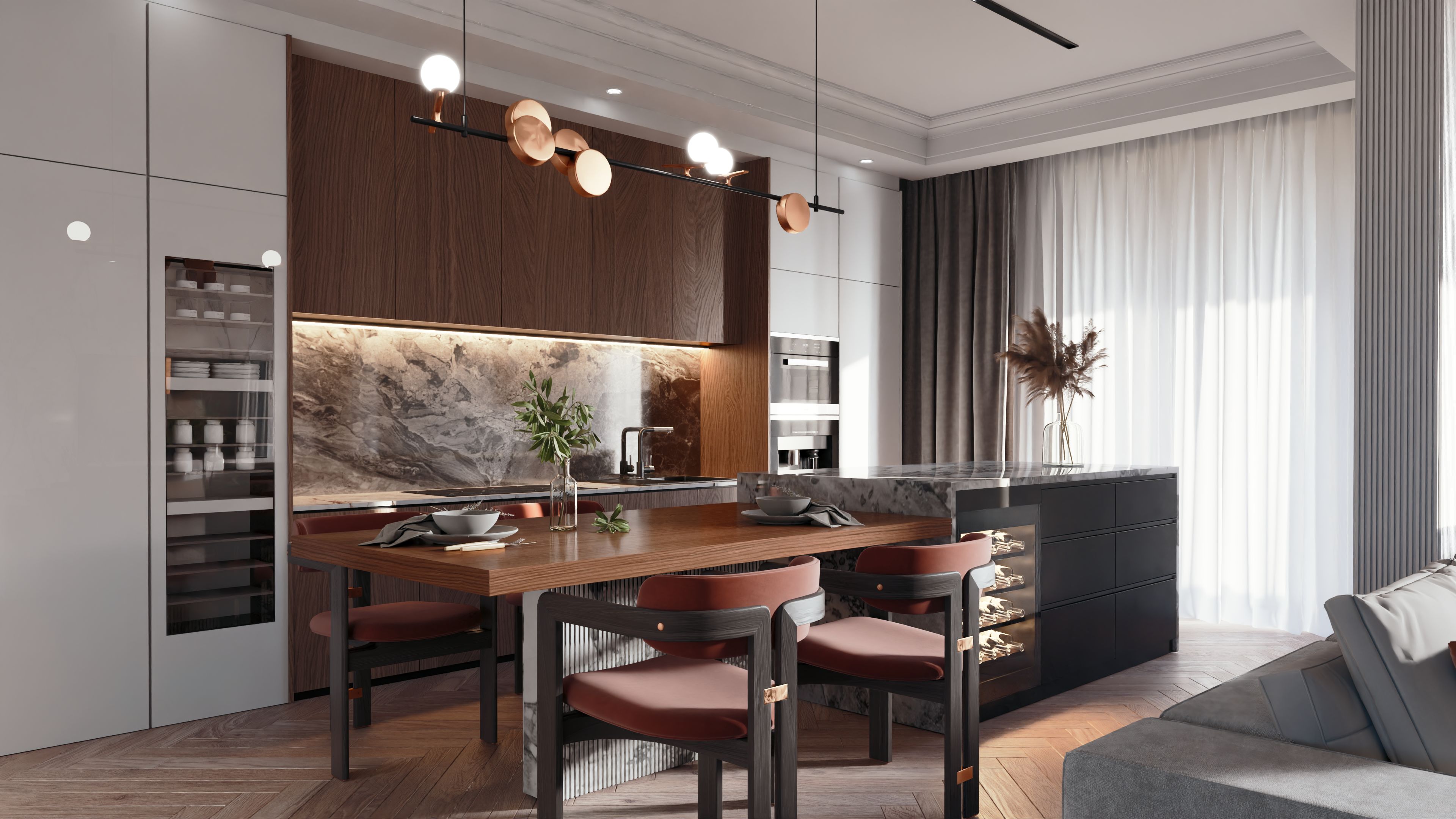
Choosing an interior design style for your Dubai villa is not the same decision it would be in London, Singapore, or New York. The starting conditions are different: the scale of the space, the quality and intensity of the natural light, the cultural context of the household, the way the indoor and outdoor spaces relate to each other, and the very specific demands the climate places on every material you specify.
A linen sofa that photographs beautifully in a Scandinavian design magazine may show dust within a week in a Dubai villa. A stark white interior that reads as crisp and minimal in a London flat feels cold and glaring under the Gulf sun. A heavily patterned traditional interior that works in a historic riad has a very different effect in a 5,000 sqft contemporary villa on the fronds.
The styles that genuinely work in Dubai villas are the ones that account for all of this — for the light, the climate, the scale, and the life that actually happens inside the space. This guide covers the six styles we see most consistently requested and most successfully executed in Dubai villa renovations and fit-outs in 2026, along with the material choices, spatial approaches, and practical considerations that make each one work.
A note on how to use this guide
These six styles are not mutually exclusive. The most successful Dubai villa interiors in 2026 are rarely pure expressions of a single label. They are considered combinations — a Japandi structural approach with biophilic material choices, or a contemporary luxury palette with New Arabic geometric detailing in the majlis. Think of each style as a vocabulary rather than a rigid formula. The goal is to find the vocabulary that suits how your household lives, and then apply it with enough discipline that the space feels coherent rather than assembled.
What Dubai’s Villas Require From Any Design Style
Before exploring individual styles, it helps to understand the conditions that every style must address in a Dubai villa. These are not stylistic preferences — they are physical and practical constraints that determine whether a design holds up over time.
Scale
Dubai villas range from 3,000 to over 15,000 square feet spread across multiple levels. This is not apartment-scale thinking. Furniture that is proportioned correctly for a European living room looks undersized and lost in a Dubai villa reception. Material choices that create warmth in a compact space create coldness in a double-height entrance hall. Every design decision needs to be calibrated to the volume of the room it occupies.
Natural Light
Dubai receives intense sunlight for most of the year. The quality of the light — a warm, golden-amber quality in the late afternoon — is genuinely beautiful and should be designed around rather than fought against. The implication for style choice: warm neutral palettes read far better under Gulf light than cool greys or stark whites. Cool tones that look sophisticated in northern European light read harsh and washed-out in Dubai.
The Indoor-Outdoor Relationship
In Dubai, the outdoor space — terrace, pool, garden — is a genuine living area for eight to nine months of the year. The design of the interior and the exterior should read as one continuous space. This means repeating the interior palette outdoors, keeping furniture profiles low near full-height glazing so the view is not interrupted, and selecting materials that transition well from inside to outside. The floor-to-ceiling glass that maximises this relationship is now standard in quality Dubai villa renovations.
Material Durability
Dubai’s climate is demanding on interior materials: intense UV exposure through glazing, temperature cycling from fully air-conditioned interiors to outdoor heat, and the ever-present fine desert dust. Materials that perform well in Dubai villa interiors include travertine, marble, onyx, treated solid wood (teak, walnut), and performance textiles (bouclé, performance linen, full-grain leather). Glossy surfaces show dust immediately. Light-coloured grout in floor tiles requires constant maintenance. Materials that look spectacular in a showroom and require constant attention in a lived-in Dubai home are poor specifications regardless of how beautiful they appear.
The Six Styles: What They Are and How They Work in Practice
Warm Minimalism — calm with character
The dominant direction in Dubai villa interiors in 2026. This is minimalism that has shed its cold, clinical associations and replaced them with natural textures, warmer tones, and materials that feel genuinely comfortable to live with rather than to photograph.
The defining shift from classic minimalism is the palette. Cool whites and grey tones — which dominated Dubai villa interiors for most of the previous decade — are being systematically replaced by warm white, cream, sand, camel, dusty rose, and soft terracotta. The reason is partly aesthetic, partly practical: warm tones work with Dubai’s afternoon light rather than against it, and they are more forgiving of the desert dust that is the reality of any Dubai home.
The structural principle of minimalism remains intact: fewer objects, more considered placement, generous negative space that makes rooms breathe. But the surfaces are tactile — a bouclé sofa, a travertine-clad feature wall, an oak floor with visible grain, a linen curtain that moves in the AC airflow. The warmth comes from the material choices, not from decoration.
In terms of spatial approach, warm minimalism in Dubai villas typically involves clean-lined built-in joinery that provides generous storage without visual clutter, neutral base surfaces with texture as the primary design element, and a lighting scheme that creates mood in the evenings rather than flooding the space with overhead brightness.
Works best in:
- Main living, dining, and kitchen areas where daily family life happens
- Master suites where calm and quality of rest are the design brief
- Spaces transitioning to outdoor terraces — the warmth reads well in both directions
- Secondary bedrooms and home office spaces where the brief is calm and focused
Watch out for: Warm minimalism fails when the material quality is not there to carry it. A beige wall next to a cheap laminate surface is just beige. The style depends on the authenticity of the materials — real travertine, not ceramic imitation. Real oak, not vinyl wrap.
Biophilic Design — nature brought in
Biophilic design — the integration of natural elements, materials, and light into interior spaces — has moved from a design trend to an expectation in Dubai villa interiors. The shift is partly driven by how Dubai residents live: the pace, the density, and the heat outside make the interior of a villa the primary place where people can feel genuinely calm. Natural materials and living elements create that calm in a way that manufactured surfaces cannot.
In practice, biophilic design in Dubai villas is not primarily about plants. It is about building the connection to nature into the architecture and the material palette — large sliding glass systems that frame garden views, double-height living spaces that flood with morning light, internal courtyards where possible, and materials whose surfaces reference the natural world: travertine’s fossil veining, the grain pattern in oak panels, the texture of handmade ceramic tiles, the coolness of natural stone underfoot.
Living elements — indoor greenery, wall-integrated planters, water features — are a genuine part of biophilic design but work best when they are designed into the architecture rather than placed afterwards. A living wall that is irrigated and lit correctly becomes a feature. A collection of potted plants in corners is something else.
The connection to wellness is real and documented. Natural light, fresh air circulation, and organic materials create environments that feel measurably calmer and more restorative than their synthetic equivalents. In a city where the indoor environment is where most life happens, this matters.
Works best in:
- Reception areas and living rooms with garden-facing glazing
- Master bathrooms designed as spa-like restorative spaces
- Kitchens where natural materials and indoor herbs create an organic connection to food
- Any room where wellness and calm are the primary brief
Watch out for: Biophilic design requires maintenance commitment. Living walls and indoor plants need water, light, and care. In a household without full-time staff or a robust automated irrigation system, the design can deteriorate quickly. Be honest about maintenance capacity before specifying living elements.
Japandi — disciplined warmth
Japandi is the synthesis of Japanese minimalism and Scandinavian warmth — two design traditions that share a commitment to craft, honest materials, and spaces that prioritise function before decoration. In Dubai villas, the style has found a strong following because it resolves the tension between minimalism and livability more successfully than either Japanese or Scandinavian design alone.
The Japanese influence brings the principle of ma — the intentional use of empty space as a design element rather than something to be filled. Low-profile furniture. Objects chosen for quality and meaning rather than abundance. An aesthetic that values the hand-made and the imperfect — wabi-sabi — over the pristine.
The Scandinavian influence brings warmth: natural wood, functional textiles, layered lighting that shifts the mood of a room from daylight to evening, and a genuine concern with how the space feels to live in over time.
In Dubai villa scale, Japandi requires careful proportional thinking. Low Japandi furniture that creates the right sense of calm in a Japanese townhouse can feel lost in a 60 sqm Dubai reception room. Japandi in a Dubai villa context needs scaled joinery — full-height cabinetry in oak or ash, custom platform beds that maintain the low profile but are proportioned to the room — to preserve the style’s sense of calm without looking sparse.
Works best in:
- Master bedrooms and suites — the style’s emphasis on calm and rest is well-suited to sleep environments
- Home libraries and study spaces where focused calm is the brief
- Guest bedrooms and bathrooms where restful simplicity is the right register
- Dining rooms in villas where the family eats together daily rather than entertaining formally
Watch out for: Japandi depends on editing. Homeowners who find it difficult to curate and maintain a reduced object count — who accumulate things — will find the style fighting them constantly. The discipline required to maintain a Japandi interior is real.
Contemporary Luxury — confident and layered
Contemporary luxury is not a single style but a sensibility: the combination of clean, modern spatial planning with premium materials, bespoke craftsmanship, and an aesthetic confidence that allows for eclecticism without chaos. In 2026, the defining characteristic of contemporary luxury in Dubai villas is the shift away from overt markers of wealth — gold-everything, marble-everywhere, chandeliers in every room — toward what is sometimes called quiet luxury: materials and finishes that speak to quality when you stand close rather than announcing themselves from the entrance.
The palette is rich but controlled. Deep charcoals and warm blacks as accent tones against warm neutral bases. Brushed brass and bronze rather than polished gold. Statement stone — book-matched marble on a feature wall, an expressive veined onyx panel backlit in the bar area, a travertine kitchen island — used intentionally rather than comprehensively. The art is part of the design brief, not an afterthought.
Technology disappears. The most important direction in contemporary luxury villa design in 2026 is the ‘invisible integration’ of smart home systems: Lutron lighting control, motorised curtains, integrated audio, and climate management — all present, none visible. Hardware is concealed within custom joinery. Speakers are integrated into ceilings or wall systems. A visible smart hub or an exposed cable is inconsistent with the aesthetic.
Statement ceilings are a defining element. Geometric gypsum coffering, ribbed wood panels running from wall to ceiling, dramatic curved plasterwork referencing Islamic geometric traditions, architectural lighting recessed into ceiling planes — these are the elements that give contemporary luxury villas in Dubai their distinctive vertical dimension.
Works best in:
- Formal reception and entertaining areas — the style performs brilliantly for hosting
- Double-height entrance halls where the architectural scale can be matched by the design
- Entertainment and cinema rooms where the high-spec AV integration is designed into the room from the start
- Master suites in premium communities (Palm Jumeirah, Emirates Hills, DIFC residences) where the finish standard needs to match the property value
Watch out for: Contemporary luxury has a budget floor. The finishes and craftsmanship quality that the style requires — book-matched stone, fully integrated smart home systems, bespoke joinery to the ceiling — are not achievable on a limited budget. Attempting the style without the budget produces something that reads as imitation rather than confidence.
New Arabic — heritage reinterpreted
The style that has perhaps gained the most momentum in Dubai villa design over the past two years is what designers are calling New Arabic or Modern Islamic: the reinterpretation of traditional Arabic and Islamic design vocabulary through contemporary materials and execution. This is not the heavily ornamented, pattern-saturated traditional Arabic interior. It is the geometric and spatial intelligence of the Arabic design tradition executed with restraint and modern craft.
The mashrabiya — the carved lattice screen that filtered light and air in traditional Arabic architecture — becomes a laser-cut metal partition creating dappled shadow across a double-height living space. The arabesque geometric pattern that historically appeared in stone or ceramic tilework is reinterpreted in backlit alabaster, or CNC-routed into timber panels, or formed in textured plasterwork. The arch, fundamental to Islamic architecture, appears as a doorway opening, a recessed niche, a mirror frame — present and referenced without being pastiche.
The majlis is one of the most important considerations in Dubai villa interior design for Arab households — and New Arabic handles it better than any other contemporary style. The majlis is a formal reception room for guests and family, often separate from the Western-influenced living spaces in the rest of the villa. It requires generous seating arranged around the perimeter, typically lower and more generous in depth than standard living room sofas, a sense of enclosure and formality, and often the richest material palette in the house. Getting the majlis right is a cultural as well as a design challenge.
For non-Arab households who are drawn to the geometric richness of this aesthetic, New Arabic works as a selective design element — a feature wall with a geometric relief pattern, a mashrabiya-inspired panel as a room divider, an arched recess in the kitchen — without requiring full commitment to the style throughout.
Works best in:
- Majlis and formal reception areas — this is where the style is most at home
- Entrance halls where the first impression sets the tone of the whole villa
- Feature walls and ceiling treatments in otherwise contemporary interiors
- Guest suites where the richness of the palette creates a hotel-quality experience
Watch out for: New Arabic requires real craft to execute well. Geometric patterns cut by hand or CNC from quality materials look extraordinary. The same pattern printed on wallpaper or applied as a vinyl decal looks exactly like what it is. The difference between the two is significant in terms of both cost and outcome.
Mediterranean Contemporary — relaxed and sun-warmed
The Mediterranean aesthetic has been a persistent influence in Dubai villa design since the city’s early villa communities were built. The original interpretation — stucco walls, terracotta roofs, columned doorways — has evolved significantly. What works in 2026 is a contemporary version: the warmth, the earthiness, the connection to outdoor living, and the generous use of natural materials, translated into cleaner architectural lines and more restrained decoration.
In material terms, Mediterranean contemporary means: limestone or travertine floors with wide joints and a honed finish, limewash or textured plaster walls in warm off-whites and dusty terracottas, arched openings (lower and more modern in profile than classical Mediterranean), solid wood furniture with natural grain, wrought iron or aged brass hardware, and a generous use of ceramic — handmade tiles in the kitchen, terracotta-toned surfaces in bathrooms, bold ceramic on a feature staircase.
The outdoor connection is fundamental to the style. Mediterranean contemporary in a Dubai villa is expressed most completely when the terrace, pool, and garden are treated as extensions of the interior — continuing the floor material outside, extending the palette to outdoor furniture and planters, and using large ceramic pots, olive trees, and Mediterranean planting to blur the boundary between inside and garden.
The style sits well with Dubai’s architectural context: the warm light flatters the earthy palette, the generosity of villa plots allows for the outdoor living emphasis, and the cultural association with warmth and hospitality resonates with the way many Dubai households actually use their homes.
Works best in:
- Family villas in established communities with generous outdoor space — Arabian Ranches, Jumeirah Park, The Meadows
- Properties where the garden and pool are a significant part of daily life for the family
- Holiday homes and short-term rental properties where the warm, relaxed aesthetic creates an immediate sense of escape
- Kitchens and bathrooms where the handmade tile and natural stone palette creates genuine character
Watch out for: Mediterranean contemporary can tip into pastiche if the contemporary discipline is lost. Heavy decorative elements, too many pattern references at once, and excessive terracotta saturation read as themed rather than designed. Restraint in the decorative layer, and quality in the material base, keep it from crossing that line.
Not Sure Which Style Suits Your Villa?
Free consultation — we help you find the design language that fits how your household lives.How to Choose: The Questions That Matter
The right style for your Dubai villa is not determined by what is currently fashionable or by what photographs best for listing photographs. It is determined by how your household actually lives, what the space structurally supports, and what you want to feel when you come home.
Here are the questions we ask every client before we begin a design brief:
- How do you actually live in the space? A villa that hosts frequent formal guests has different design requirements from one that is primarily a private family home. A home office that needs to feel separate and focused requires a different approach from a studio that is used occasionally. The life that happens in the space shapes every design decision above it.
- What do you want to feel when you walk in? Not what do you like in isolation, but what would you be happy looking at every day for five years? Styles that feel exciting in a hotel room or a showroom can feel exhausting at home if they are too demanding or too far from your natural sensibility.
- What are you willing to maintain? Warm minimalism and Japandi depend on consistent editing — they fight accumulation. Mediterranean contemporary requires seasonal maintenance of outdoor planting. Biophilic design with living walls needs irrigation and light management. Some styles have higher maintenance requirements than others, and being honest about this at the briefing stage saves significant regret later.
- Who is actually going to live here? In a Dubai villa with 12 family members across three generations, the design requirements for the communal spaces are very different from a villa occupied by a couple working from home. The household composition shapes the brief more than any aesthetic preference.
- What is the budget reality — and where does it matter most? A full style commitment throughout a large villa is a substantial investment. Understanding early which rooms will receive the full treatment and which will be done at a more restrained level allows the budget to go where it creates the most impact.
The most successful villa interiors we have designed at Malmö Interiors are rarely the ones where a client arrived with the firmest aesthetic brief. They are the ones where the client was honest about how they live and what they need — and trusted us to translate that into a design language that they might not have arrived at themselves.
Materials That Perform in Dubai Villas in 2026
Regardless of which style direction you choose, some material choices consistently outperform others in Dubai’s climate and lifestyle context. This is not about aesthetics — it is about what holds up.
- Stone flooring: Travertine and limestone (honed, not polished): durable, heat-resistant, age beautifully, and read as warm even in large floor areas. The natural variation in the surface means individual marks and wear become part of the character rather than defects. The most consistently specified luxury floor material in Dubai villa interiors in 2026.
- Marble: Marble is still widely used in Dubai villa design, particularly for bathroom surfaces, kitchen islands, and feature walls. The practical shift in 2026 is toward expressive, veined varieties — books-matched Calacatta or Statuario for feature applications, robust Carrara or Arabescato for high-use surfaces. Polished marble floors in main circulation areas require more maintenance than honed travertine.
- Solid wood and engineered wood: Solid oak, teak, walnut, and ash are specified across Dubai villa interiors for flooring, wall panelling, joinery, and furniture. The key specification requirement in Dubai: fully acclimatised solid wood installed in an AC-conditioned environment with controlled humidity. Engineered wood is more dimensionally stable where AC is less consistent. Gloss wood finishes show dust immediately — matte or satin oil finishes are more practical.
- Textiles: Bouclé, performance linen, and full-grain leather are the three textile categories that consistently perform in Dubai villa living. Bouclé has the warmth and texture that defines the 2026 material palette without the maintenance demands of natural linen. Performance linen looks organic and relaxed while resisting the dust and pet hair that natural linen attracts. Full-grain leather ages correctly in Dubai’s AC-controlled interiors and does not suffer from the humidity-related issues it faces in coastal climates.
- Metals and hardware: Brushed brass, bronze, and aged matte black are the hardware finishes across all six styles in 2026. Polished chrome, satin nickel, and – with very few exceptions – bright polished gold are out of step with the current material direction. Hardware choices extend to door handles, cabinetry pulls, bathroom fixtures, light switch plates, and curtain poles. Consistency across all of these in a single metal family (or two closely related ones) is one of the details that separates interiors that feel designed from those that feel assembled.
How Malmö Interiors Approaches Style
We do not arrive at a project with a preferred style that we try to apply to every space we work on. We arrive with a process — a set of questions, a design fluency across multiple style directions, and an understanding of what works in Dubai’s specific physical and cultural context — and we use it to find the right style for your villa and your household.
We have designed in all six directions described in this article, often in combination. We have delivered warm minimalist family villas in Arabian Ranches that feel personal and lived-in rather than showroom-ready. We have executed contemporary luxury finishes in Palm Jumeirah properties where the brief was a premium rental specification. We have designed New Arabic majlis spaces that our clients’ families use daily and feel genuinely at home in.
The style question is always secondary to the brief question. What is the space for? Who will use it? How does this household actually live? The answers to those questions determine which style vocabulary serves the project. The rest — the material selections, the palette, the furniture, the lighting — follows from there.
You can see examples of our completed villa interior design projects in our portfolio, or read about our eight-step design process in our interior design process guide.
Frequently Asked Questions
Ready to Explore What Works for Your Villa?
Finding the right design direction for your villa is the conversation we most enjoy having. Bring us your space, your household, and your sense of what you are looking for — even if that sense is only partially formed — and we will help you find the design language that fits.
Book a Free Consultation with Malmö Interiors
Interior design, renovation, and fit-out for Dubai villas, apartments, and commercial spaces.
Call or WhatsApp: +971 4 268 2347
Email: info@malmo-interiors.com
Contact us to arrange your first conversation, or explore our completed projects for style inspiration.


