.svg)
Flooring Guide for Dubai Homes: Marble, Porcelain, SPC & Wood Compared (2026)
Flooring is one of the most important decisions in any Dubai home renovation. It is the largest continuous surface in your home, the element that sets the visual tone of every room, and the one material that every single person who enters your property will walk on, touch, and form an instant impression about.
It is also the decision where the most money is wasted through poor material selection — particularly in Dubai, where the combination of extreme summer heat, intense UV, high humidity from coastal proximity, and continuous AC cycling creates a climate that is genuinely harsh on flooring materials that perform perfectly well in other parts of the world.
This guide compares the four most commonly chosen flooring types for Dubai homes — marble, porcelain, SPC vinyl, and engineered wood — with verified 2026 cost data, honest performance assessments for Dubai's specific climate, and clear room-by-room recommendations. We do not include estimates or assumption-based figures: every cost cited has a verified source.
Verified Cost Summary (2026)
Porcelain tiles: AED 50-150 per sqm installed (standard); AED 150-300 per sqm installed (large-format). Source: taamir.ae, May 2026.
Natural marble: AED 300-800 per sqm installed. Source: taamir.ae, May 2026. (UAE local marble: AED 250-500/sqm; Italian imported: AED 500-1,200/sqm. Source: malmo-interiors.com Blog 1.)
SPC flooring: AED 35-85 per sqm supply; AED 120-260 per sqm installed. Sources: onlineflooring.ae Dec 2025; interiofy.ae Dec 2025.
Engineered wood: AED 90-300 per sqm supply; AED 260-680 per sqm installed (villa living room). Sources: onlineflooring.ae Dec 2025; interiofy.ae Dec 2025.
Demolition of existing flooring: AED 8-15 per sqm additional. Source: malmo-interiors.com Blog 1.
Why Dubai's Climate Changes the Flooring Decision
Choosing flooring for a Dubai home is not the same as choosing flooring anywhere else in the world. The UAE climate creates specific performance demands that most international flooring guides do not address — and ignoring them leads to premature failure, costly replacement, and difficult conversations with contractors.
- Extreme heat: Summer air temperatures of 45…50°C and surface temperatures significantly higher. Flooring in a Dubai villa's entrance hall or areas exposed to direct sunlight can reach 60…70°C on a summer day. Materials that expand or contract under heat — solid hardwood, laminate, and some vinyl products — fail in these conditions through buckling, gapping, or delamination.
- AC-driven humidity cycling: Dubai's coastal position creates ambient humidity, but indoor AC use creates the opposite: rapid moisture extraction from the air. The daily cycling between high outdoor humidity and aggressively air-conditioned indoor environments creates thermal and moisture expansion-contraction cycles that are particularly hard on natural wood flooring.
- UV intensity: Direct sunlight in Dubai through large windows and glass doors causes UV fading of materials that are not UV-stabilised. Over 12-18 months, UV-sensitive flooring in south-facing rooms fades visibly.
- Acoustic performance in high-rise buildings: Dubai's dense apartment and villa developments mean that noise transmission between floors is a genuine concern. Flooring that provides acoustic insulation is a significant quality-of-life benefit in high-rise buildings.
- Maintenance in a dusty environment: Flooring that can be kept clean with minimal effort is essential in Dubai, where fine desert dust enters homes constantly, and family living with children and pets puts cleaning demands on surfaces daily.
The fundamental rule for Dubai flooring: Choose materials that are dimensionally stable under both heat and humidity variation. This single criterion eliminates solid hardwood and standard laminate from most Dubai indoor applications and elevates porcelain and quality SPC as the most climate-appropriate choices.
Porcelain Tiles for Dubai Homes
Porcelain is the most widely used flooring in Dubai — and for good reason. It is the most climate-resilient material available, performing reliably in every application from swimming pool surrounds to air-conditioned bedrooms. Understanding the different types and specifications within porcelain helps you make a better choice.
What Porcelain Tile Is
Porcelain is fired at higher temperatures and to greater density than ceramic. It is virtually non-porous (water absorption below 0.5%), making it genuinely waterproof rather than merely water-resistant. In Dubai, where bathroom waterproofing failures are a leading cause of neighbour disputes, non-porous porcelain is the correct specification for any wet area.
Modern porcelain technology can replicate marble, wood, concrete, travertine, and stone surfaces with high visual accuracy — without the maintenance requirements of the originals. Marble-effect porcelain has become one of the most popular flooring choices in Dubai apartments precisely because it delivers the aesthetic of marble with none of marble's maintenance demands.
Large-Format Porcelain: The 2026 Trend in Dubai Homes
The most significant shift in Dubai flooring in recent years is the move to large-format porcelain tiles. Where 60x60cm was the standard in Dubai homes a decade ago, 60x120cm and 80x160cm formats have become the dominant specification in mid-range and premium renovations. The reason is primarily visual: fewer grout lines make spaces feel larger, cleaner, and more contemporary.
Large-format porcelain requires a more level substrate (maximum variation of 3mm over 2 metres) and more skilled installation than standard tiles. Poor installation of large-format tiles results in hollow spots, cracking under point loads, and lippage at joints. Specify a skilled installer, not just a cheap one.
Dubai Climate Performance
- Heat and climate stability: Completely unaffected by heat, UV, or humidity variations. No expansion or contraction regardless of temperature.
- Waterproof performance: Non-porous porcelain is the correct choice for wet areas. Required in bathrooms where any flooring failure can cause water damage to lower floors.
- Maintenance: Porcelain is easy to clean with standard household cleaners. Does not harbour bacteria, allergens, or dust mites.
- Slip resistance: Polished porcelain in wet areas can be slippery. Specify a minimum R10 slip resistance rating for bathroom and kitchen floors. Large-format tiles in wet zones require linear drainage channels rather than central point drains to maintain the correct fall.
- Comfort: Hard underfoot, which can cause discomfort when standing for extended periods in kitchens. Cold underfoot in winter months when AC runs continuously.
- Grout maintenance: Grout lines accumulate dirt and discolouration over time, particularly in kitchens. Epoxy grout is the correct specification for Dubai kitchens and bathrooms: non-porous, stain-resistant, and mould-resistant. See Blog 5 for detail on grout selection.
Verified Cost: Porcelain Tiles in Dubai (2026)
Best Rooms for Porcelain in Dubai Homes
- All bathrooms — the only appropriate specification in wet areas
- Kitchens — durable, easy to clean, grease-resistant
- Living and dining areas — especially in large-format finishes
- Hallways and entrance areas — high traffic, easy maintenance
- Balconies and outdoor areas — must specify exterior-rated anti-slip porcelain
- Rental apartments — durable, low-maintenance, tenant-proof
Natural Marble Flooring for Dubai Homes
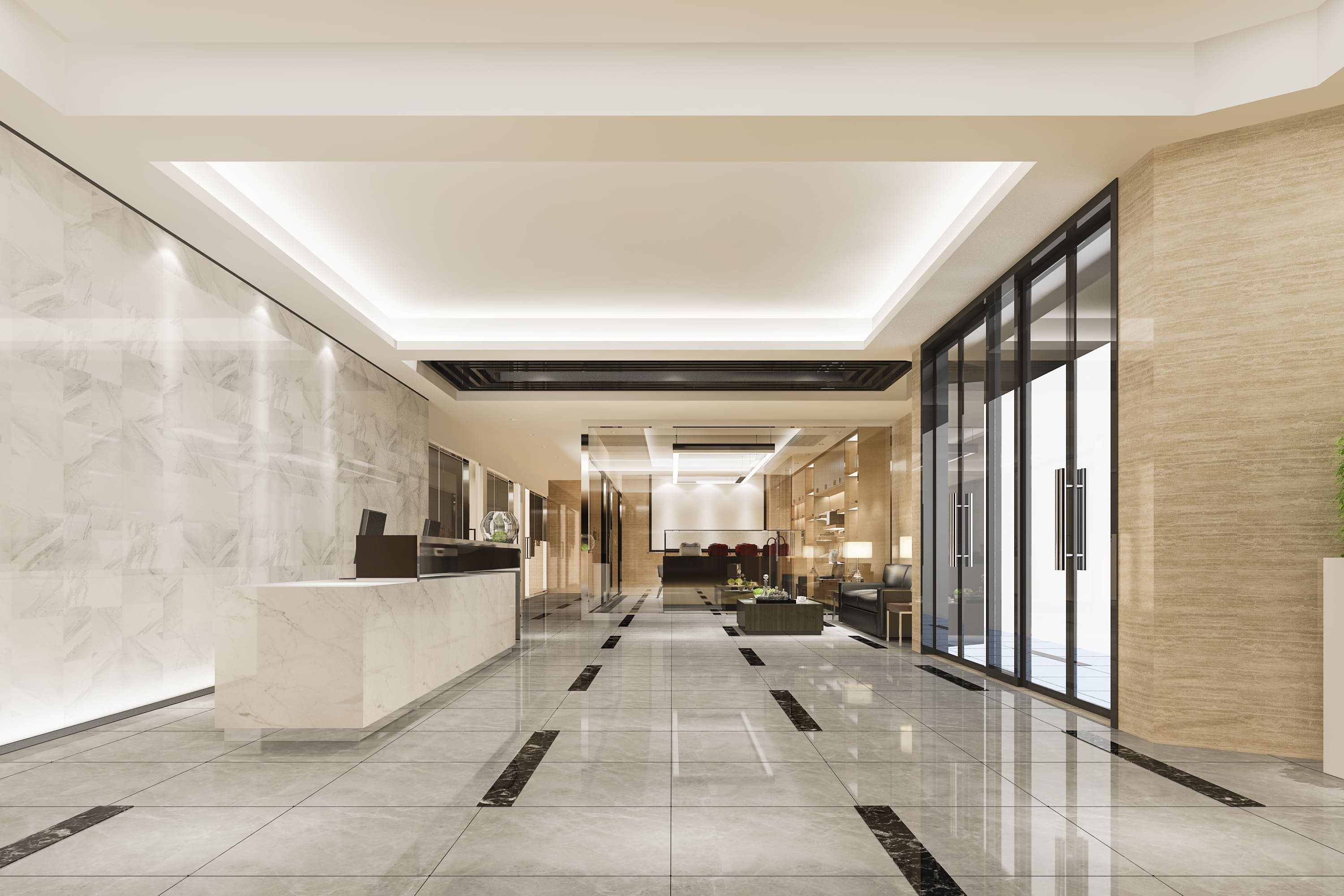
Marble is the prestige flooring choice in Dubai. It appears throughout the city's premium residential and hotel interiors, and it is the automatic visual signal of luxury in a Dubai property. Understanding what marble actually costs, how it performs in Dubai's climate, and what it demands in maintenance is essential before choosing it.
Types of Marble Relevant to Dubai
- Local marble: UAE local marble: Quarried and processed domestically or regionally. Includes cream, beige, and light grey varieties. More cost-effective than European imports. Quality varies.
- Italian marble: Italian marble (Calacatta, Statuario, Bianco Carrara): The premium choice for luxury Dubai interiors. Dramatic veining, bright white backgrounds. Significantly more expensive than local marble.
- Turkish marble: Turkish marble: Mid-range option, widely available in Dubai. Good quality at price points between local and Italian.
- Travertine: Travertine: Technically a limestone rather than marble, but commonly specified alongside marble in Dubai interiors. Warm cream and honey tones. Requires sealing. Popular in 2026 for its organic aesthetic.
Dubai Climate Performance
- Heat expansion: Natural stone expands marginally in heat and contracts in AC-cooled interiors. This is manageable in standard applications but requires proper expansion joints in large continuous marble floor installations. Omitting expansion joints causes cracking over time.
- Porosity and sealing: All marble is porous to varying degrees. It must be sealed before use and resealed annually in Dubai's conditions. Unsealed marble in a kitchen or bathroom will stain permanently within weeks.
- Acid sensitivity: Marble is susceptible to acid etching. Lemon juice, wine, vinegar, and many cleaning products will etch polished marble surfaces permanently. This is a practical consideration for kitchen or dining room marble floors.
- Thermal properties: Marble stays genuinely cool underfoot even in Dubai's summer heat — which is a comfort advantage in living areas.
- Slip risk when wet: Polished marble is the most slip-resistant hazard in wet conditions in a Dubai home. Marble bathrooms should use honed rather than polished marble, and must have a correctly sloped floor with adequate drainage.
Verified Cost: Natural Marble in Dubai (2026)
Best Rooms for Marble in Dubai Homes
- Entrance halls and formal lobbies — the classic Dubai marble application, where visual impact matters most and foot traffic patterns are lighter
- Living areas in premium properties — where the aesthetics justify the maintenance commitment
- Master bathroom floor in honed finish — premium feel, but requires careful waterproofing and non-slip specification
- Feature elements: fireplace surrounds, bathroom vanity countertops, statement floors in small areas
What marble is not ideal for in Dubai: Kitchens (acid etching from food and cleaning products), high-traffic areas with children and pets (scratching and staining), any wet area in a polished finish (slip risk), and any rental property (maintenance cost and fragility incompatible with tenancy turnover).
SPC Flooring for Dubai Homes: The Climate-Optimised Choice
SPC (Stone Plastic Composite) flooring has become one of the fastest-growing flooring categories in Dubai over the past three years — and for specific, verifiable reasons that align with Dubai's climate requirements. Understanding what SPC actually is, why it outperforms older flooring categories in the UAE, and where it belongs in a Dubai home is essential for making an informed specification.
What SPC Flooring Is
SPC is a rigid-core luxury vinyl flooring. The core is made from limestone powder, PVC, and stabilising agents compressed into a dense rigid board. On top of the core sits a printed design layer (which can replicate wood, stone, marble, or concrete with high realism) and a wear layer of 0.3-0.5mm or more that protects against scratches and surface wear.
The defining characteristic of SPC for Dubai applications is its dimensional stability: the limestone-PVC composite core does not meaningfully expand or contract under heat, cold, or humidity variation. Unlike solid hardwood which expands across the grain in heat, unlike laminate which swells when it absorbs moisture, SPC maintains its dimensions across the full range of UAE temperature and humidity conditions.
Dubai Climate Performance
- SPC's rigid composite core remains dimensionally stable under Dubai's extreme temperatures. Testing under EN ISO 23999 confirms less than 0.10% dimensional change, which is why SPC does not buckle, gap, or warp in UAE conditions. Laminate, by comparison, fails in Dubai's humidity cycles because its HDF core absorbs moisture.
- Waterproof: SPC is 100% waterproof. The stone-composite core does not absorb water. It can be installed in bathrooms, kitchens, laundry rooms, and any other wet area in a Dubai home.
- UV and wear resistance: SPC with a UV-stable wear layer maintains its colour and design under Dubai's UV intensity. Quality SPC products carry AC3 or AC4 commercial wear ratings, meaning they are specified for high-traffic commercial applications as well as residential.
- Comfort and acoustics: SPC flooring is softer and warmer underfoot than porcelain tile, reducing joint fatigue when standing in kitchens and reducing the noise of footfall — an important consideration in Dubai high-rise apartments.
- Maintenance: SPC is straightforward to clean with dry mopping and occasional damp mopping with an SPC-appropriate cleaner. It does not harbour dust mites, bacteria, or allergens. Spills wipe clean without staining.
Verified Cost: SPC Flooring in Dubai (2026)
Best Rooms for SPC in Dubai Homes
- Bedrooms — warm and comfortable underfoot, easy to clean, dimensionally stable in AC conditions
- Living and family rooms — durable, comfortable, suitable for family use with children and pets
- Kitchens — waterproof, easy to clean, more forgiving underfoot than porcelain
- Hallways and high-traffic areas — AC3 commercial wear rating handles heavy foot traffic
- Rental apartments — extremely durable, easy to maintain between tenancies, cost-effective
- Home offices — comfortable for extended standing and chair castor use (specify commercial-grade AC3 rating minimum)
Engineered Wood Flooring for Dubai Homes
Engineered wood brings genuine natural wood beauty and warmth to Dubai homes in a form that is significantly more climate-tolerant than solid hardwood. Understanding the construction of engineered wood — and why it is the correct choice over solid hardwood for the UAE — is important before specifying it.
What Engineered Wood Flooring Is
Engineered wood consists of a real hardwood veneer — typically 3-6mm of natural timber — bonded over a plywood or high-density fibreboard core of multiple cross-laminated layers. The cross-lamination gives engineered wood its dimensional stability advantage over solid hardwood: the alternating grain directions resist expansion and contraction forces.
The result is a floor that looks and feels like real hardwood because the visible surface layer is real hardwood, but behaves more like a composite in response to humidity and temperature changes. In Dubai's climate, this distinction is critical.
Engineered Wood vs Solid Hardwood in Dubai: Why It Matters
Solid hardwood is not recommended for Dubai indoor applications.
Solid hardwood expands and contracts significantly with humidity and temperature changes. Dubai's combination of summer outdoor humidity, aggressively air-conditioned interiors, and extreme temperatures creates the conditions where solid hardwood suffers most: gapping in winter when AC is maximum and swelling in the humid summer transition periods.
Engineered hardwood resists these movements significantly better due to its cross-laminated plywood core. For any Dubai application requiring the look of real wood, engineered hardwood is the correct specification. Multiple verified Dubai flooring suppliers specifically recommend engineered over solid for UAE climate. (Source: onlineflooring.ae Dec 2025; yallarenovation.com 2025)
Dubai Climate Performance
- Climate stability: Engineered wood handles Dubai's climate better than solid hardwood, though it still requires controlled humidity in the space it is installed in (60-65% relative humidity is the recommended range for most engineered wood products in Dubai).
- Water resistance: Engineered wood is not waterproof. It should not be used in bathrooms, directly on balconies, or in any area where standing water is possible. Surface water spills should be wiped immediately.
- Comfort and acoustics: Natural wood is warmer underfoot than porcelain and quieter. The warmth and acoustic properties of engineered wood are its primary lifestyle advantages.
- Species selection for Dubai: Teak is the species with the highest natural oil content and best native resistance to Dubai's humidity. Oak is the most widely available and cost-effective. Walnut is a premium choice for its rich visual character.
- Refinishability: Engineered wood can typically be sanded and refinished once or twice during its lifespan (depending on the veneer thickness). This extends the practical life of the floor significantly compared to SPC, which cannot be refinished.
- Maintenance: Wood requires periodic maintenance with appropriate wood floor cleaners. It should not be wet-mopped. High humidity areas should be avoided.
Verified Cost: Engineered Wood Flooring in Dubai (2026)
Best Rooms for Engineered Wood in Dubai Homes
- Bedrooms — where warmth, comfort, and aesthetics are the priority and humidity control is achievable
- Home offices — professional aesthetic with acoustic comfort
- Living rooms in premium villas — where the warmth and visual richness of real wood justifies the higher cost and maintenance requirement
- Formal dining areas in lower-humidity, well-air-conditioned environments
What engineered wood is not ideal for in Dubai: Bathrooms and kitchens (moisture exposure will damage even engineered wood), balconies or outdoor areas (never), any rental property where tenant maintenance standards cannot be guaranteed, or any space without reliable climate control.
Marble, Porcelain, SPC & Engineered Wood: The Full Comparison Table
Room-by-Room Flooring Recommendations for Dubai Homes
What About Ceramic, Laminate, and Microcement?
Beyond the four main categories above, three additional flooring materials appear regularly in Dubai homes. Here is where they sit honestly in the Dubai context.
Ceramic Tile
Ceramic is fired at a lower temperature than porcelain, making it more porous (water absorption above 3%) and less durable. Verified cost: AED 60-200 per sqm installed (yallarenovation.com 2025). Ceramic is acceptable for dry areas in budget applications but is not the correct specification for bathrooms or kitchens where porcelain should be used. In Dubai, most renovations now specify porcelain over ceramic even at modest price points because the performance difference justifies the modest cost difference.
Laminate
Laminate uses a photographic image layer over a high-density fibreboard (HDF) core. Verified cost: AED 30-100 per sqm supply (floorsndecks.com). Laminate is not recommended for Dubai homes. The HDF core absorbs moisture and swells in Dubai's humidity cycles, causing edge lifting, buckling, and joint failure. Multiple Dubai renovation specialists specifically warn against laminate. SPC delivers similar visual results with none of laminate's climate vulnerabilities, at a comparable or only marginally higher cost.
Microcement (Seamless Finish)
Microcement is a thin cement-based coating applied to existing surfaces to create a seamless, contemporary finish with no grout lines. It is growing in popularity in premium Dubai apartments and bathrooms where the absence of grout lines is aesthetically desirable. Cost in Dubai: AED 200-450 per sqm applied (previously cited in Blog 5 on bathroom renovation). Microcement requires specialist application and correct sealing; improperly applied microcement cracks or stains. It can be a premium alternative to tiling in bathrooms and living areas when applied by an experienced specialist.
Flooring Supply and Installation with Malmo Interiors
Malmo Interiors supplies and installs all major flooring types across Dubai — from large-format porcelain in villa living rooms and kitchen renovations to SPC in apartment bedrooms, engineered wood in premium interiors, and marble in entrance halls and master bathrooms. Flooring is one of the highest-impact elements of any renovation, and our team manages material selection, procurement, substrate preparation, and installation as an integrated process.
What we provide on every flooring project:
Material advice specific to your space — We recommend the right flooring for each room based on the actual use case, humidity exposure, existing substrate condition, and your budget. We do not recommend one material for every room because no single material is right for every room in a Dubai home.
Transparent, itemised quotation — Supply cost and installation cost listed separately. Substrate preparation, demolition of existing flooring, and underlayment all itemised. No surprises.
Correct substrate preparation — Large-format tile installation requires a levelled substrate within 3mm over 2 metres. We check and prepare the substrate before installing. Skipping substrate preparation is the most common cause of hollow tiles, cracking, and lippage.
Quality installation — Pattern alignment, correct grout joint size, expansion joints at perimeters and doorways, epoxy grout specification in wet and kitchen areas. These details matter for the long-term performance of any flooring installation.
For more on renovation costs including flooring, see our villa renovation cost guide, our apartment renovation guide, and our bathroom renovation guide.
Frequently Asked Questions — Flooring for Dubai Homes
What is the best flooring for a Dubai home?
For most Dubai homes, large-format porcelain is the best all-round choice: completely waterproof, unaffected by heat and humidity, durable, easy to clean, and available in designs that replicate marble, wood, concrete, and stone. For bedrooms and living areas where comfort underfoot is a priority, SPC is the best climate-optimised choice in most budget ranges, with engineered hardwood an excellent option in premium applications. Marble is the prestige choice for entrance halls and formal living areas in premium properties. Never use solid hardwood or laminate in Dubai indoor applications.
How much does flooring cost in Dubai?
Verified 2026 costs: Standard porcelain AED 50-150 per sqm installed. Large-format porcelain AED 150-300 per sqm installed. Natural marble AED 300-800 per sqm installed. SPC flooring AED 120-260 per sqm installed. Engineered wood AED 260-680 per sqm installed. Demolition of existing flooring adds AED 8-15 per sqm. Sources: taamir.ae May 2026, interiofy.ae Dec 2025, onlineflooring.ae Dec 2025, malmo-interiors.com 2026.
Is SPC flooring good for Dubai?
Yes — SPC is one of the best flooring choices specifically for Dubai's climate. Its rigid limestone-PVC composite core is dimensionally stable under Dubai's extreme temperatures and humidity cycling, meaning it does not buckle, gap, or warp. It is 100% waterproof, making it suitable for kitchens and bathrooms as well as all living areas. It is softer and quieter underfoot than porcelain. It costs significantly less than marble or engineered wood. SPC is particularly well-suited to rental apartments, family homes with children and pets, and any space where durability and easy maintenance are priorities.
Can you use marble flooring in Dubai?
Yes, but it requires commitment. Marble is the prestige flooring choice in Dubai and appears throughout premium residential interiors. It must be properly sealed before installation and resealed annually. It is porous and susceptible to staining from food, wine, lemon juice, and acidic cleaners. Polished marble in wet areas is a serious slip hazard — use honed finish with adequate drainage in bathrooms. It is not appropriate for rental properties or high-traffic family areas. For the visual effect of marble without the maintenance, marble-effect large-format porcelain is an excellent alternative.
Why is solid hardwood not recommended for Dubai homes?
Solid hardwood expands and contracts significantly in response to temperature and humidity changes. Dubai's combination of extreme summer heat, heavily air-conditioned interiors, and high coastal humidity creates conditions where solid hardwood suffers most: gapping in winter when AC runs continuously and swelling in the humid transition periods between seasons. Engineered hardwood is the correct specification for any Dubai application where real wood is desired — its cross-laminated plywood core resists dimensional change far more effectively than solid wood. Multiple Dubai flooring specialists specifically recommend against solid hardwood for UAE indoor applications.
What flooring is best for a rental apartment in Dubai?
For rental apartments, porcelain or quality SPC are both excellent choices. Both are durable, easy to clean, resistant to the wear and tear of tenancy turnover, and require minimal ongoing maintenance by tenants. Porcelain is the most durable long-term option but harder underfoot. SPC is warmer, quieter, and more comfortable for tenants while still being very durable. Both deliver strong rental appeal across Dubai's main rental markets. Avoid marble (staining and maintenance risk), engineered wood (moisture sensitivity, tenant maintenance required), and laminate (fails in Dubai humidity) for rental properties.
Planning to Change the Flooring in Your Dubai Home?
Whether you are renovating a villa, upgrading an apartment for rental, or selecting flooring for a new fit out, Malmo Interiors can help you choose the right material for each room based on your actual use case, budget, and renovation scope — and install it correctly.
We provide a free on-site consultation where we assess your existing substrate, discuss your goals and budget, and recommend the right flooring specification for each room. We follow up with a transparent, itemised quotation covering supply, substrate preparation, demolition where needed, and installation.
.png)
.svg)
.svg)
.svg)
.svg)